
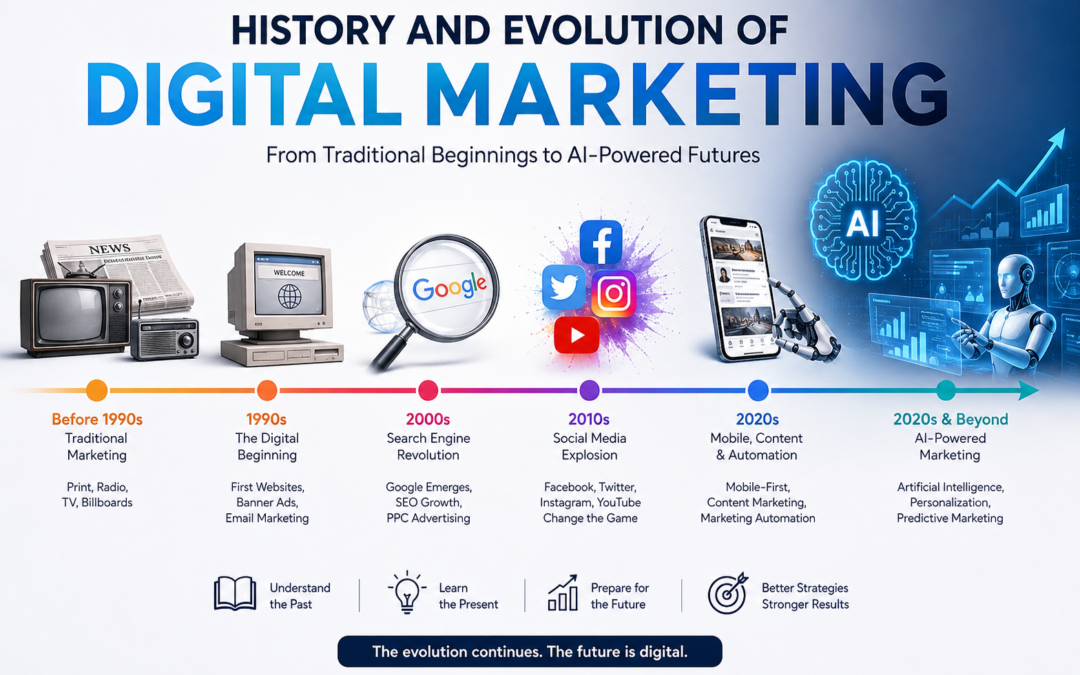
The Complete Evolution from Traditional Advertising to AI-Powered Digital Marketing:
What Is Digital Marketing?
Digital marketing is the process of promoting products or services using digital channels such as websites, search engines, email, social media platforms, mobile apps, and online advertisements.
Unlike traditional marketing, digital marketing allows businesses to reach the right audience at the right time. It also helps measure campaign performance in real time.
Examples of digital marketing include:
- Search Engine Optimization (SEO)
- Content Marketing
- Email Marketing
- Social Media Marketing
- Pay-Per-Click (PPC) Advertising
- Affiliate Marketing
- Influencer Marketing
- Video Marketing
- Mobile Marketing
- Marketing Automation
Understanding the History of Digital Marketing makes it easier to see why these channels have become essential for businesses of every size.
Why Understanding the History of Digital Marketing Matters
Many people focus only on today’s marketing trends. However, learning the History of Digital Marketing provides valuable insights into why modern strategies work.
Businesses that understand the past can better prepare for future changes.
Benefits of learning the History of Digital Marketing include:
- Understanding how consumer behavior has changed.
- Learning why search engines became so important.
- Seeing how social media transformed communication.
- Discovering how data helps businesses make smarter decisions.
- Preparing for future technologies like artificial intelligence.
The History of Digital Marketing is not just about technology. It is also about people. As customers changed the way they searched, shopped, and communicated, businesses had to change too.
Marketing Before the Internet
Before digital marketing existed, businesses relied on traditional advertising methods.
Some of the most popular channels included:
Newspapers
Newspapers were one of the earliest advertising platforms. Companies paid to display advertisements so local readers could discover their products and services.
Although newspaper advertising reached large audiences, it was difficult to measure results.
Radio Advertising
Radio became popular during the twentieth century.
Businesses used radio commercials to introduce new products and build brand awareness.
Radio advertising allowed companies to reach thousands of listeners at once.
Television Advertising
Television changed advertising forever.
Companies could now combine sound, motion, and storytelling.
Brands invested heavily in television commercials because they attracted millions of viewers.
However, television advertising was expensive and difficult for small businesses.
Billboards and Outdoor Advertising
Outdoor advertisements appeared along highways, bus stops, train stations, and busy streets.
These advertisements increased brand visibility but offered no interaction with customers.
Problems with Traditional Marketing
Traditional marketing was effective for many years, but it had several limitations.
These included:
- High advertising costs
- Limited audience targeting
- Difficult performance tracking
- Slow communication
- One-way messaging
- Limited customer feedback
These challenges created opportunities for a new way of marketing.
That opportunity arrived with the internet.
The Birth of Digital Marketing
The History of Digital Marketing officially began during the early 1990s.
As personal computers became more affordable and internet access expanded, businesses realized they could communicate directly with customers online.
This changed marketing forever.
Instead of waiting for customers to see newspaper advertisements or television commercials, businesses could publish information instantly on websites.
Customers could now search for information whenever they wanted.
This simple shift completely changed buying behavior.
The First Clickable Banner Advertisement
One of the biggest milestones in the History of Digital Marketing occurred in 1994.
AT&T launched what is widely recognized as the first clickable banner advertisement.
The advertisement appeared on HotWired.com and invited users to click.
Its click-through rate was remarkably high compared with modern standards because internet users had never experienced interactive advertising before.
This campaign proved that digital advertising could attract attention and encourage action.
Many marketers consider this moment the beginning of online advertising as we know it today.
Early Business Websites
During the mid-1990s, businesses rushed to create websites.
Initially, these websites acted like digital brochures.
They contained:
- Company information
- Product descriptions
- Contact details
- Office locations
Over time, websites evolved into complete marketing platforms capable of generating leads, processing payments, publishing educational content, and providing customer support.
This transformation marked another major chapter in the History of Digital Marketing.
Search Engines Begin to Organize the Internet
As more websites appeared online, finding information became increasingly difficult.
Search engines solved this problem.
Some early search engines included:
- Archie
- AltaVista
- Yahoo!
- Lycos
- Ask Jeeves
These platforms helped users discover websites by entering keywords.
For businesses, this created an entirely new opportunity.
If customers searched for products online, appearing in search results became extremely valuable.
This realization eventually gave birth to Search Engine Optimization (SEO).
The Beginning of SEO
SEO began as website owners looked for ways to improve their rankings in search engines.
Early SEO techniques focused on simple website optimization.
As search engines evolved, SEO also became more sophisticated.
Modern SEO now includes:
- Helpful content
- Technical optimization
- User experience
- Page speed
- Mobile responsiveness
- Structured data
- Search intent
- High-quality backlinks
- Topical authority
Today, SEO remains one of the most important outcomes of the History of Digital Marketing, helping businesses attract organic traffic without relying solely on paid advertising.