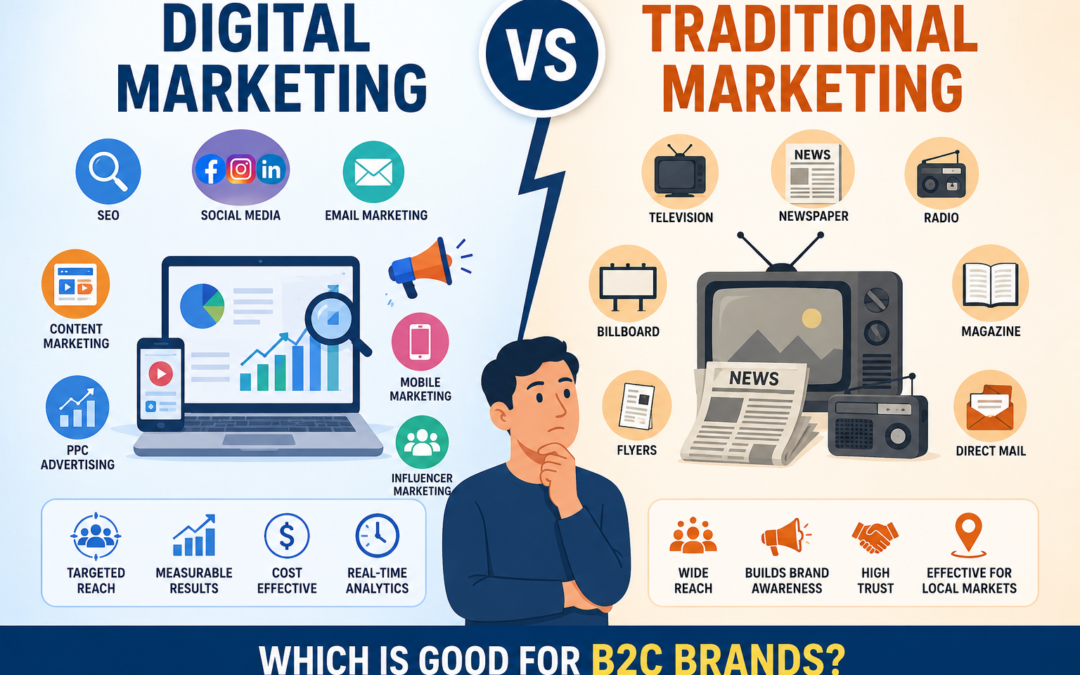
Marketing has changed dramatically over the last two decades. Businesses that once relied on newspapers, television commercials, radio advertisements, and billboards now have access to powerful online channels that can reach millions of consumers instantly.
For B2C (Business-to-Consumer) brands, choosing between digital marketing and traditional marketing is one of the most important decisions. The right marketing strategy can increase brand awareness, attract new customers, improve engagement, and boost sales.
Many businesses often ask:
- Is digital marketing better than traditional marketing?
- Should B2C brands focus only on online marketing?
- Does traditional advertising still work?
- Which marketing method provides the highest return on investment?
This guide explores the differences, advantages, disadvantages, costs, effectiveness, and future trends of digital marketing and traditional marketing for B2C brands.
Understanding B2C Marketing
Before comparing both approaches, it is important to understand what B2C marketing means.
B2C stands for Business-to-Consumer. It refers to businesses that sell products or services directly to customers.
Examples include:
- Clothing brands
- Restaurants
- E-commerce stores
- Beauty brands
- Fitness companies
- Mobile phone brands
- Food and beverage companies
B2C customers often make purchasing decisions quickly. Their buying behavior is influenced by emotions, convenience, reviews, recommendations, and brand perception.
This is why effective marketing is critical.
What Is Digital Marketing?
Digital marketing refers to promoting products and services through online channels.
A modern digital marketing agency helps brands connect with consumers through various digital platforms and technologies.
Common Digital Marketing Channels
Search Engine Optimization (SEO)
SEO helps websites rank higher on Google and other search engines.
Benefits include:
- Organic traffic
- Long-term visibility
- Better credibility
- Increased leads
Content Marketing
Content marketing involves creating:
- Blog posts
- Articles
- Videos
- Guides
- Infographics
A digital marketing agency often uses content marketing to educate and attract potential customers.
Social Media Marketing
Platforms include:
- TikTok
- YouTube
- X (Twitter)
Social media allows brands to interact directly with consumers.
Email Marketing
Email marketing helps businesses:
- Nurture leads
- Increase repeat purchases
- Promote products
- Build loyalty
Pay-Per-Click Advertising (PPC)
Examples include:
- Google Ads
- Facebook Ads
- Instagram Ads
Businesses only pay when users click their advertisements.
Influencer Marketing
Influencers help brands gain credibility and exposure among targeted audiences.
What Is Traditional Marketing?
Traditional marketing includes offline advertising methods that existed before the internet became mainstream.
Common Traditional Marketing Channels
Television Advertising
TV commercials remain popular among large consumer brands.
Radio Advertising
Radio advertisements help reach local and regional audiences.
Newspaper Advertising
Businesses use newspapers to promote products and services.
Magazine Advertising
Magazines target specific demographics and interests.
Billboards
Outdoor advertising remains highly visible in busy locations.
Direct Mail
Businesses send promotional materials directly to consumers.
Key Differences Between Digital Marketing and Traditional Marketing
1. Reach
Digital Marketing
Digital marketing can reach audiences worldwide instantly.
A digital marketing agency can launch a campaign today and attract visitors from multiple countries within hours.
Traditional Marketing
Traditional marketing often focuses on local or regional audiences.
Winner: Digital Marketing
2. Targeting Capabilities
Digital Marketing
Businesses can target users based on:
- Age
- Gender
- Location
- Interests
- Online behavior
- Purchase history
A digital marketing agency can create highly specific audience segments.
Traditional Marketing
Targeting options are limited.
For example, a billboard is visible to everyone passing by.
Winner: Digital Marketing
3. Cost Effectiveness
Digital Marketing
Small businesses can start with modest budgets.
Benefits include:
- Lower advertising costs
- Flexible spending
- Better ROI
Traditional Marketing
TV commercials and newspaper ads often require larger investments.
Winner: Digital Marketing
4. Measurability
Digital Marketing
Everything can be tracked:
- Website visits
- Click-through rates
- Conversions
- Sales
- Engagement
A digital marketing agency can analyze campaign performance in real time.
Traditional Marketing
Measuring performance is much more difficult.
Winner: Digital Marketing
5. Customer Engagement
Digital Marketing
Customers can:
- Like
- Share
- Comment
- Review
- Message brands directly
This creates two-way communication.
Traditional Marketing
Communication is mostly one-way.
Winner: Digital Marketing
Advantages of Digital Marketing for B2C Brands
Better Customer Targeting
Digital marketing allows businesses to reach ideal customers more accurately.
Higher ROI
Many businesses achieve stronger returns through digital campaigns.
Real-Time Optimization
Campaigns can be adjusted instantly.
Global Reach
Brands can expand beyond local markets.
Stronger Customer Relationships
Social media and email create direct communication channels.
Data-Driven Decisions
A digital marketing agency uses analytics to improve performance continuously.
Advantages of Traditional Marketing for B2C Brands
Strong Brand Recognition
Television and billboards create broad awareness.
High Credibility
Consumers often trust established media channels.
Local Market Impact
Traditional advertising works well for local businesses.
Wider Reach Among Older Audiences
Older demographics often consume traditional media regularly.
Challenges of Digital Marketing
High Competition
Thousands of businesses compete online.
Constant Algorithm Changes
Search engines and social platforms frequently update algorithms.
Learning Curve
Businesses must stay updated with changing trends.
Challenges of Traditional Marketing
High Costs
Advertising expenses can be significant.
Limited Analytics
Tracking performance is difficult.
Less Flexibility
Campaign changes often require additional costs.
Digital Marketing vs Traditional Marketing Cost Comparison
Digital Marketing
Typical channels:
- SEO
- Social Media Marketing
- Email Marketing
- PPC Advertising
- Content Marketing
Advantages:
- Flexible budgets
- Scalable campaigns
- Lower entry costs
Traditional Marketing
Typical channels:
- TV Ads
- Radio Ads
- Billboards
- Newspapers
Advantages:
- Mass visibility
Disadvantages:
- Higher investment
- Limited targeting
For most B2C brands, digital marketing offers better value for money.
Which Marketing Strategy Delivers Better ROI?
ROI measures the return generated from marketing investments.
Digital marketing usually delivers higher ROI because businesses can:
- Target precisely
- Optimize campaigns quickly
- Track results accurately
A professional digital marketing agency can continuously improve campaign performance using real-time data.
Traditional marketing may still produce strong ROI for large-scale awareness campaigns, but tracking results is more difficult.
When Should B2C Brands Choose Digital Marketing?
Digital marketing is ideal when:
- Budget is limited
- Online sales are important
- Data tracking is required
- Younger audiences are targeted
- Growth is a priority
Many successful B2C brands rely heavily on a digital marketing agency to manage their online presence.
When Should B2C Brands Choose Traditional Marketing?
Traditional marketing may be effective when:
- Building mass awareness
- Targeting older consumers
- Promoting local businesses
- Launching major brand campaigns
The Best Approach: Integrated Marketing
The smartest B2C brands combine both approaches.
Example:
A fashion brand may:
- Run TV advertisements
- Promote products on Instagram
- Invest in SEO
- Use influencer marketing
- Launch Google Ads
This integrated strategy maximizes reach and engagement.
A digital marketing agency often coordinates these channels to create a unified customer experience.
Future Trends in B2C Marketing
Artificial Intelligence
AI helps brands personalize customer experiences.
Voice Search Optimization
Consumers increasingly use voice assistants.
Video Marketing
Short-form video continues to dominate engagement.
Influencer Marketing Growth
Authentic recommendations remain powerful.
Hyper-Personalization
Customers expect tailored experiences.
A forward-thinking digital marketing agency adapts quickly to these evolving trends.
Final Verdict: Digital Marketing vs Traditional Marketing
For most B2C brands, digital marketing provides greater flexibility, lower costs, stronger targeting, better power word analytics, and higher ROI.
Traditional marketing remains valuable for brand awareness and reaching specific audiences.
Instead of choosing one over the other, businesses should focus on creating an integrated marketing strategy that combines the strengths of both.
As consumer behavior continues to move online, investing in digital marketing is no longer optional. It is essential for long-term business growth.
Partnering with an experienced digital marketing agency can help B2C brands maximize visibility, generate leads, increase conversions, and stay competitive in a rapidly changing marketplace.